What makes it strong aroma
Strong aroma is the largest-selling style in China by a wide margin, and the one most exported bottles belong to. The name refers to aroma intensity, not alcohol — the style spans 38% to 54% ABV. What defines it is a specific ester, ethyl hexanoate, which reads as pineapple and ripe apple, sitting on top of a honeyed sweetness and a dusty cellar note.
That cellar note is not a flaw. It comes from the fermentation vessel: a pit dug into the ground and lined with mud, used continuously for years or decades without being emptied. The pit mud hosts a bacterial community — Clostridium among them — that produces the fatty acids which become those fruity esters. Older pits make better spirit, which is why distilleries guard pit age the way a winery guards vine age.
Within the style there are regional accents worth knowing. Sichuan strong aroma is the benchmark: broad, rich, high in ester. The Jiangsu and Anhui schools, on the Yangtze’s lower reaches, deliberately pull back — lower ABV, softer texture, less cellar. The trade calls that 绵柔, soft and continuous, and it is the reason a bottle from Suqian tastes different from one from Luzhou at the same strength.
How it is made
The defining technique is 续糟配料: rather than starting from fresh grain each time, a portion of the fermented mash is carried over into the next round and topped up with new sorghum. The pit is never fully emptied, so the microbial community and the acidity stay stable. Some distilleries describe their mash as 万年糟 — ten-thousand-year mash — because in principle the lineage never breaks.
Grain and fermenting mash are steamed together in the same pot, a step called 混蒸混烧, so the new sorghum absorbs aroma from the older material while it cooks. Fermentation runs 60 to 90 days depending on the season and the house style, then the cycle repeats.
Pit age is the quality lever. A new pit gives a thin, sharply alcoholic spirit. After a decade the mud has developed the right bacterial balance and the spirit gains the dense fruit and the roundness that the style is prized for. The famous 1573 pits at Luzhou have been in continuous use since the Ming dynasty, and they are a protected heritage site rather than a marketing line.
In the glass
Nose
Pineapple and ripe apple first, then honey and a little cooked pear. The cellar note sits underneath — damp earth, old wood — and should read as depth rather than mustiness. Cheap bottles push the fruit to the front and leave nothing behind it.
Palate
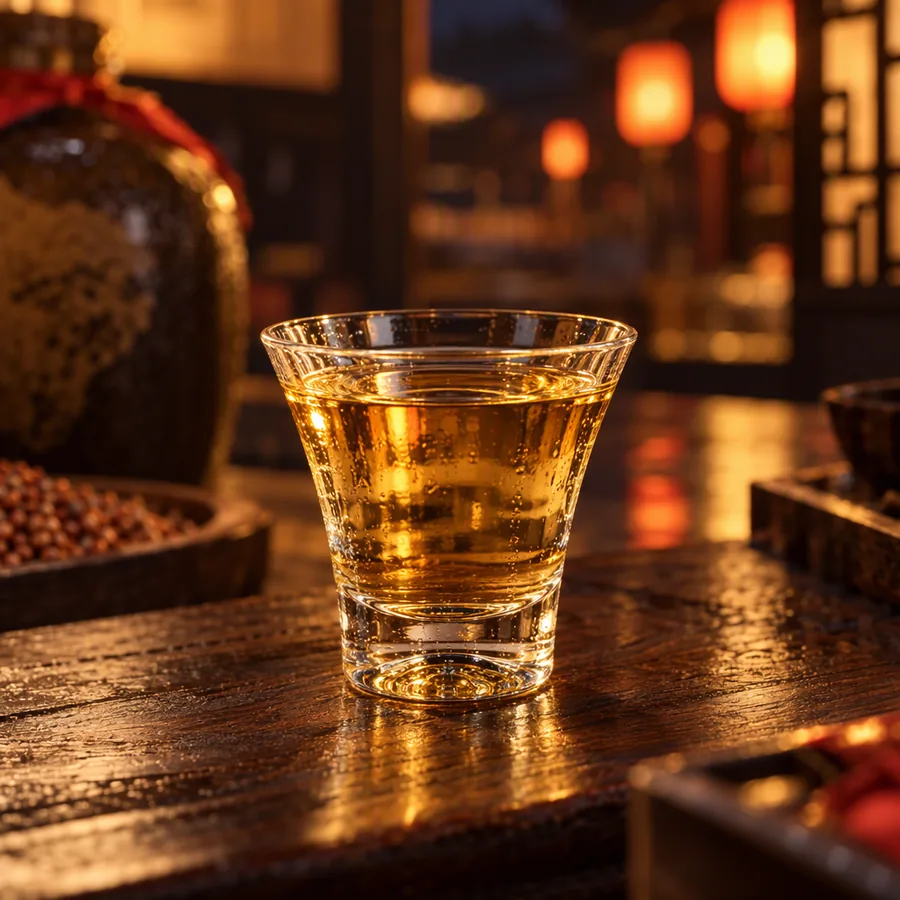
Sweet entry, round and slightly oily in the middle, with the fruit turning toward honey and baked grain. Acidity is low, which is what makes it so easy to drink alongside food. At 52% the alcohol is present but should not be sharp.
Finish
Medium to long, warm, with the fruit fading into a soft grain sweetness. The best bottles leave a cooling, faintly floral trace; the weakest turn bitter at the back of the throat.
How to serve it
| Temperature | Room temperature, 18–22°C |
|---|---|
| Glass | Small tulip, 15–20 ml |
| Pour | Neat; a splash of water is acceptable at 52%+ |
| Pace | With food, across a whole meal |
| Food | Roast meat, Sichuan cold dishes, dumplings, hotpot |
What people get wrong
- “Strong means higher alcohol.”
- It means stronger aroma. The style runs from 38% to 54%, and the low-ABV versions are made by the same houses from the same pits.
- “If it tastes sweet, sugar was added.”
- The sweetness comes from esters and from glycerol produced during fermentation. Adding sugar is not permitted under the style standard, and it would taste flat rather than round.
- “All strong aroma is the same recipe.”
- Single-grain (sorghum only) and multi-grain houses produce noticeably different spirits, and the Sichuan, Jiangsu and Anhui schools differ in body and ABV by design.