What makes it sauce aroma
Sauce aroma is named for a family resemblance, not for soy sauce. What the name points at is the savoury, fermented, roasted register that dominates the glass: fermented soybean paste, roasted peanut, dried mushroom, a wisp of smoke. Behind that sits a deep base of cooked grain and dried fruit. No other baijiu style is this savoury, and none divides drinkers this sharply.
The style is defined less by a recipe than by heat and time. The qu starter is made at 60–65°C, hot enough to kill most of the moulds that other styles rely on and to select for thermophilic bacteria instead. Fermentation happens in stone-walled pits with mud floors, and the whole cycle runs a full year before a single bottle is possible. That cost is why the style sits at the top of the price ladder.
In the Chinese classification, sauce aroma is one of the twelve recognised aroma types, and the one with the strongest regional identity: the Chishui River valley in northern Guizhou and its continuation into southern Sichuan. Bottles made outside that valley exist, but the reference points are all from there.
How it is made
Production follows a fixed calendar. Qu is made at the Dragon Boat Festival in early summer, when temperatures are high enough for the starter to cure hot. Grain is fed in at the Double Ninth Festival in autumn, in two rounds — the second feeding is what the trade calls 下沙, adding fresh sorghum to the already-fermenting mash. From there the mash is steamed, fermented, and distilled eight times over the following year, with spirit drawn off seven times.
Those seven draws are not the same liquid. The early draws are sharp and high in alcohol; the middle draws carry the body; the late draws are softer and more acidic. Each is stored separately, then blended — a step called 盘勾 — so that the final bottle is a construction rather than a single distillation. Base spirit rests at least three years in ceramic jars, and premium bottlings blend across several vintages.
The heat is what makes the flavour. Because the qu cures above 60°C, the enzymes that would produce the fruity esters of strong aroma are largely destroyed, and the fermentation instead produces pyrazines and phenolic compounds. That single choice explains why sauce aroma tastes roasted and strong aroma tastes of pineapple.
In the glass
Nose
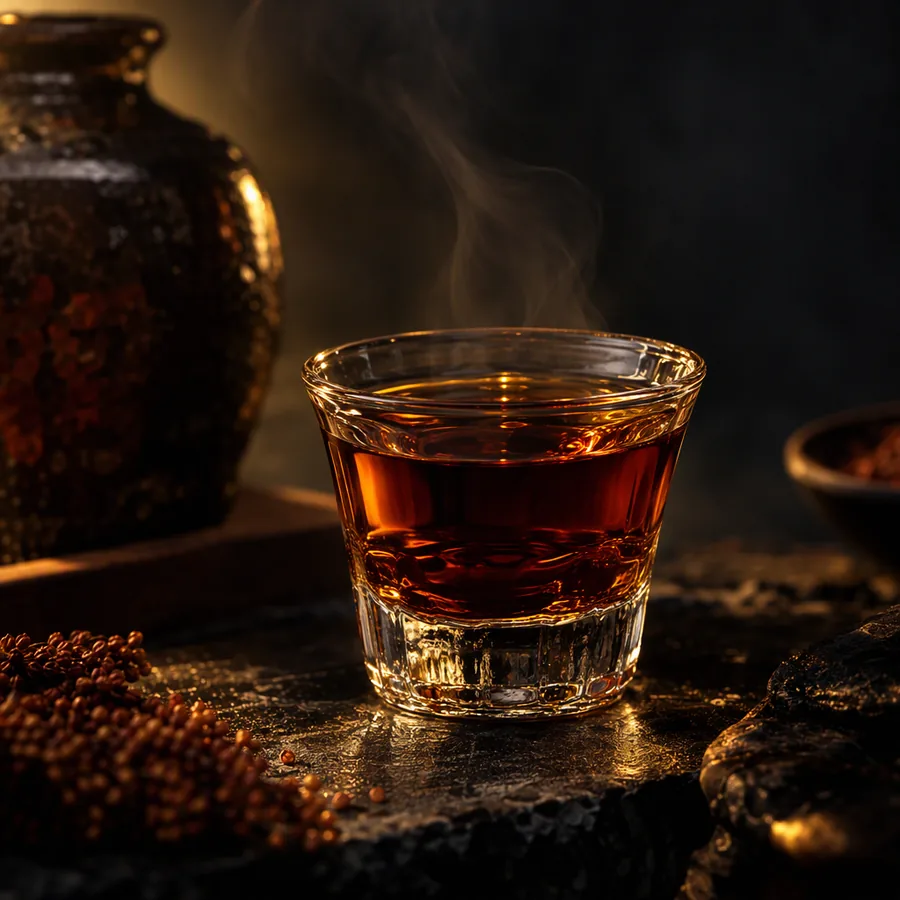
Fermented soybean, roasted peanut, dried shiitake, a little smoke and clove. Fruit is present but dried rather than fresh — apricot, dates. In young bottles the savoury note is blunt; with age it separates into layers.
Palate
Full and warming, with a savoury mid-palate that carries soy and roasted grain. There is sweetness, but it arrives late and reads as a return rather than an entry. Texture is oily and slightly viscous at 53%.
Finish
Very long, and the defining test of the style. The savoury note fades into a sweet, cooling aftertaste that can sit for a minute or more. Cheap sauce aroma collapses here; good bottles keep unfolding.
How to serve it
| Temperature | Room temperature, 18–22°C |
|---|---|
| Glass | Small tulip or 15 ml tasting glass |
| Pour | 15–20 ml, no ice, no water in the glass |
| Pace | Sip in thirds; let the glass sit 5 minutes first |
| Food | Braised meat, fermented bean dishes, aged cheese |
What people get wrong
- “It tastes like soy sauce.”
- The name describes a savoury, fermented register, not literal soy sauce. Nobody who tastes it blind reaches for a condiment bottle.
- “Sauce aroma means Moutai prices.”
- The style has an entry level. The bottles in this database start around US$30 and the spread to the flagship is more than tenfold, so the style is not the same thing as the brand.
- “Older is always better.”
- Age helps, but storage decides. A bottle kept in a hot car for a summer is worse than a young one kept properly. Age statements on Chinese labels also describe the base spirit, not the whole blend.